Momentum Logistics Services
A complete logistics platform for a Poland-based company — a public marketing website, a full user dashboard for shipment creation and tracking, and an admin CMS with role-based access control. Replaced a manual, visit-based estimation process with automated carrier rate calculation and a KSef-compliant invoicing system.
Project Overview
Momentum Logistics Services (MLS) is a shipping and logistics company based in Poland, helping clients send packages domestically and internationally via FedEx, DHL, and other carriers. The business had a functioning invoicing tool internally, but no public web presence and no automated way to generate shipping estimates — every quote required manual intervention, often including in-person visits.
The engagement covered three interconnected products, each living in its own codebase:
- mls-client — A Next.js application serving both the public marketing website and the authenticated user dashboard, where customers manage shipments, get estimates, and pay invoices
- mls-admin — A separate Next.js admin dashboard for staff and administrators, with RBAC, user and shipment management, commission configuration, and security controls
- mls-server — An Express.js backend (running on Bun) providing the REST API, business logic, carrier integrations, payment processing, invoicing, and email/SMS services
Tech Stack
Client & Admin (Frontend)
- Next.js (App Router) — Server components for marketing pages, client components for the interactive shipment dashboard and admin UI
- TypeScript — Strict type safety with Zod schemas for all form inputs and API responses
- Tailwind CSS + shadcn/ui — Admin dashboard built on shadcn/ui primitives; client app uses a custom CSS variable design system
- Zustand — Lightweight global state for auth, shipment, invoice, and country stores
- TanStack Query + React Hook Form — Data fetching, caching, and form validation
- Google Places API — Address autocomplete and verification throughout the shipment creation flow
Backend
- Express.js on Bun — REST API with OpenAPI 3.0 documentation auto-generated from Zod schemas
- PostgreSQL + Prisma — Relational data store with 30+ migrations; Zod schemas auto-generated from Prisma models
- FedEx API + DHL eCommerce API + Inpost API — Rate estimation, service level options, and shipment tracking
- Stripe + PayU Poland — Dual payment gateways with automatic fallback logic and webhook verification
- Nodemailer + Brevo SMTP — Transactional emails — invoices, password resets, shipment notifications, and payment reminders
- Twilio — Phone number verification via SMS
- Free Currency API — Real-time exchange rates for multi-currency support
The Problem
MLS was operating without a web presence and with a largely manual client intake process. Two specific pain points made scaling the business difficult:
- No marketing website — the company had no public-facing presence. New clients discovered them only through referral, and there was no way to communicate their services, coverage, or pricing online
- Manual package estimation — to generate a shipping estimate, staff needed the exact dimensions and weight of a package. Because clients rarely had this information to hand, staff frequently had to contact them directly — and in many cases, physically visit them to measure and photograph packages themselves
Operational Cost of Manual Estimation
The visit-based estimation workflow was expensive in time and resource:
- Travel overhead: Staff made in-person visits purely to measure packages — time that could be spent on actual logistics operations
- Manual photography: Packages were photographed on-site to document dimensions and condition before quotes could be prepared
- Quote delays: A process that should be instantaneous took hours or days, depending on staff availability and travel distance
- No self-service option: Clients had no way to explore pricing independently — every enquiry required direct staff involvement, regardless of complexity
- Existing invoicing tool, nothing else: The company had an internal invoicing system but nothing customer-facing — no dashboard, no tracking, no online payment flow
Marketing Website
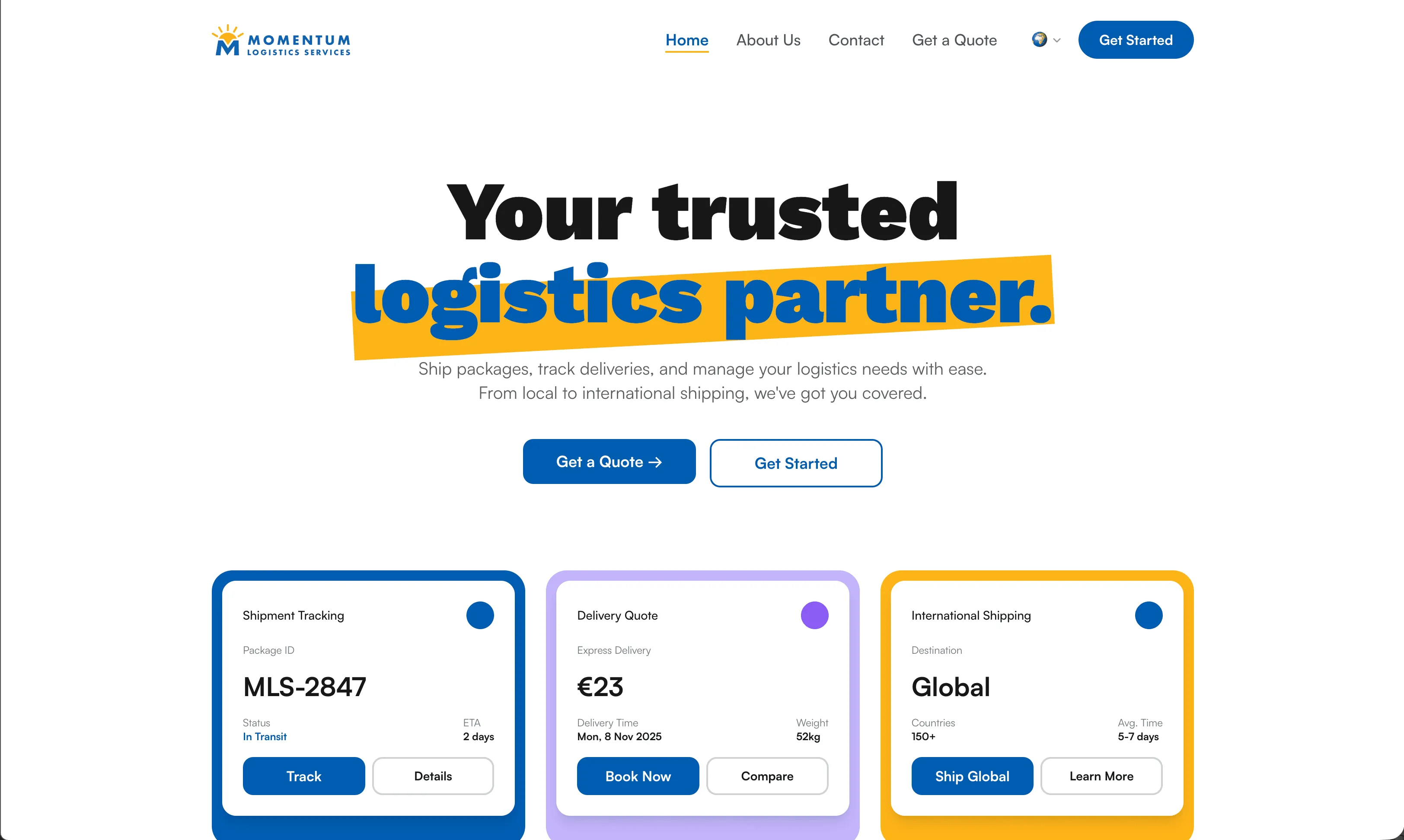
The client-facing Next.js application includes a full public marketing section — service pages, coverage information, and calls-to-action routing prospective clients into the registration and estimate flows. Marketing pages use Next.js server components for fast initial loads and good SEO performance.
Shipment Estimation & Creation
The core user journey — getting a shipping estimate — is now entirely self-service:
- Users enter package dimensions and weight manually, or select from a set of common package presets
- The platform queries FedEx and DHL in parallel, normalises responses, and returns a comparison of available service levels (Standard, Express, etc.) with real-time pricing
- Volumetric weight is calculated automatically, and the greater of actual vs. volumetric weight is used for accurate pricing
- Estimates include a full pricing breakdown — base rate, applicable taxes, surcharges — in the user's local currency via real-time exchange rate conversion
- Saved estimates can be converted into shipments and paid through the dashboard; estimates expire after 24 hours
Invoicing System (KSef-Compliant)
MLS operates under Polish tax regulations, so the invoicing system was built with KSef compliance in mind:
- Invoices are generated automatically on shipment confirmation, with itemised line items, tax breakdowns, and unique invoice IDs
- Multiple invoice statuses — draft, issued, paid, cancelled, refunded — with lifecycle management and configurable expiry
- PDF export and email delivery via Brevo SMTP with EJS templates
- Automatic payment reminder emails at 1 day before expiry, on expiry, and every 3 days after — configurable per invoice
- Admin interface for viewing, resending, voiding invoices, and managing the full refund workflow (request → approve → execute)
Payment Processing
Two payment gateways cover MLS's Poland-based user base and international clients:
- Stripe — Card payments via webhook-verified checkout; primary gateway for most users
- PayU Poland — Native Polish payment processing via hosted checkout, using OAuth 2.0 Client Credentials flow
- Automatic fallback: If the primary gateway does not respond within 15 seconds, the system silently retries through the secondary gateway — transparent to the user
- Webhook-primary verification with a polling fallback (every 30 seconds for up to 5 minutes) ensures payment status reliability across both providers
Authentication & Security
- JWT-based auth — short-lived access tokens paired with long-lived refresh tokens; bcrypt password hashing
- Full verification flows — email verification on registration, phone verification via Twilio SMS, OTP-based email change and address update workflows
- Password management — reset via OTP code, in-dashboard password change, admin-initiated rotation
- Super-admin OTP login — enhanced security for super-admin accounts; automatic password rotation on a configurable schedule (30/60/90 days)
- Activity audit logging — all user and admin actions logged with actor, action, resource, timestamp, and before/after values
Admin CMS & RBAC
The admin dashboard is a separate Next.js application (mls-admin) with a flat, minimalist design built on shadcn/ui:
- Three-tier role hierarchy: Super Admin (full system access) → Admin → Staff (limited, configurable permissions)
- Granular permissions across users, shipments, invoices, payments, refunds, and tax rules — each independently toggleable per role
- User management: directory, profile editing, ban/unban, shipment and estimate history per user
- Carrier management: dynamic carrier listing, commission configuration per carrier, 4-stage hierarchical commission system with threshold-based tiers
- Shipment management: full lifecycle view, status override, payment bypass for flagged shipments
- Address verification: OTP-initiated address change requests flow through an admin approval/rejection interface
Outcomes
- Manual site visits eliminated — clients self-serve dimensions (or use presets), and the platform returns accurate carrier rates instantly
- End-to-end shipment lifecycle online — estimate, create shipment, pay, receive invoice, track delivery — all without staff involvement for standard shipments
- KSef-compliant invoicing in production — invoices generated, delivered, and managed within Polish tax requirements
- Dual-gateway payment resilience — automatic Stripe → PayU fallback prevents failed payments from breaking the checkout flow
- Contract value and scope expanded — the quality of deliverables led the client to extend the engagement and increase the contract scope beyond the original brief
Key Learnings
- Three-repo architecture pays off at scale: Separating the client app, admin dashboard, and backend into independent codebases allowed each to evolve at its own pace — the admin dashboard adopted shadcn/ui while the client app kept its custom design system, without either imposing constraints on the other.
- Payments need a fallback, not just a handler: Building the Stripe → PayU fallback with a 15-second timeout proved its value during a Stripe outage. No user saw an error; they were silently routed to PayU.
- Compliance is a feature: KSef compliance wasn't a checkbox — it shaped the invoice data model, the numbering system, the expiry logic, and the admin interface. Building it in from the start was far cheaper than retrofitting it later.
- Presets reduce friction significantly: Adding common package size presets to the estimate form dramatically reduced the number of users who abandoned the flow at the dimensions step.